
ZIPPY KLEAN Technician Steve was absolutely a Professional. He answered all of our questions before we knew to ask it. We got the Worx package for OUR 2025 Ford Bronco and are extremely satisfied. Stay tuned for the 6 weeks report, the time it takes for the clear coat to cure. We would HIGHLY RECOMMEND ZIPPY KLEAN TO HELP MAINTAIN YOUR CAR IN PRISTINE CONDITION. MAHALO STEVE FOR YOUR PROFFESIONAL AND ALOHA ATTITUDE.
Home › RV & Motorhome Ceramic Coating
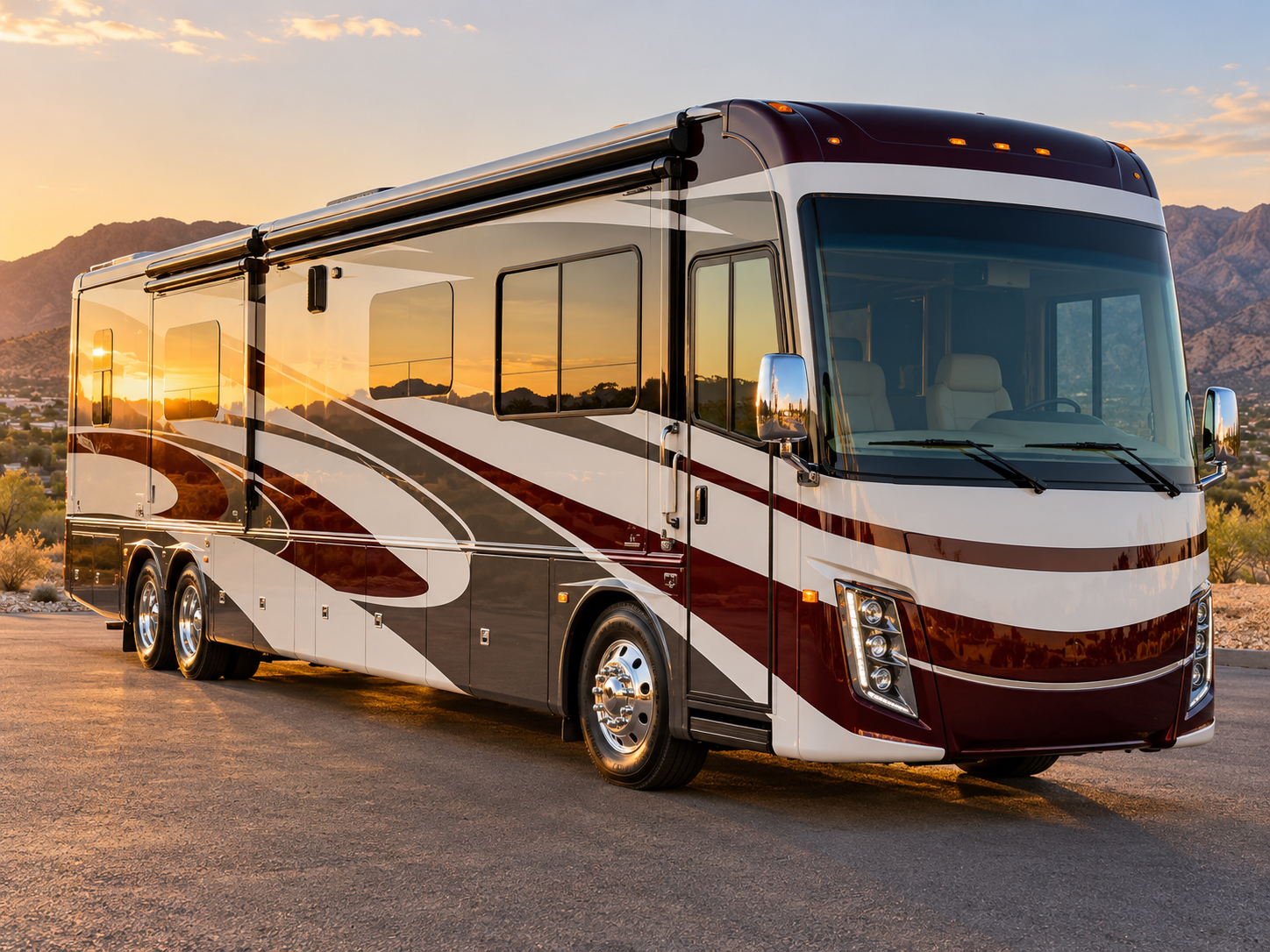
We coat 40-footers outdoors
No bay goes over a Class A, so we use the method developed for private aircraft — a protective spray over the coating while it cures. We have been coating jets on open tarmac since 2019. Your coach gets done where it is parked.
From $20.70 / ft detailed
From $103.50 / ft coated
Aircraft since 2019
Mobile — own water & power
Visual proof
Before and after
Oxidised gelcoat is the defining RV problem in Southern California. It is not dirt, it is the surface of the fiberglass breaking down — and it is why a ten-year-old coach looks twenty.
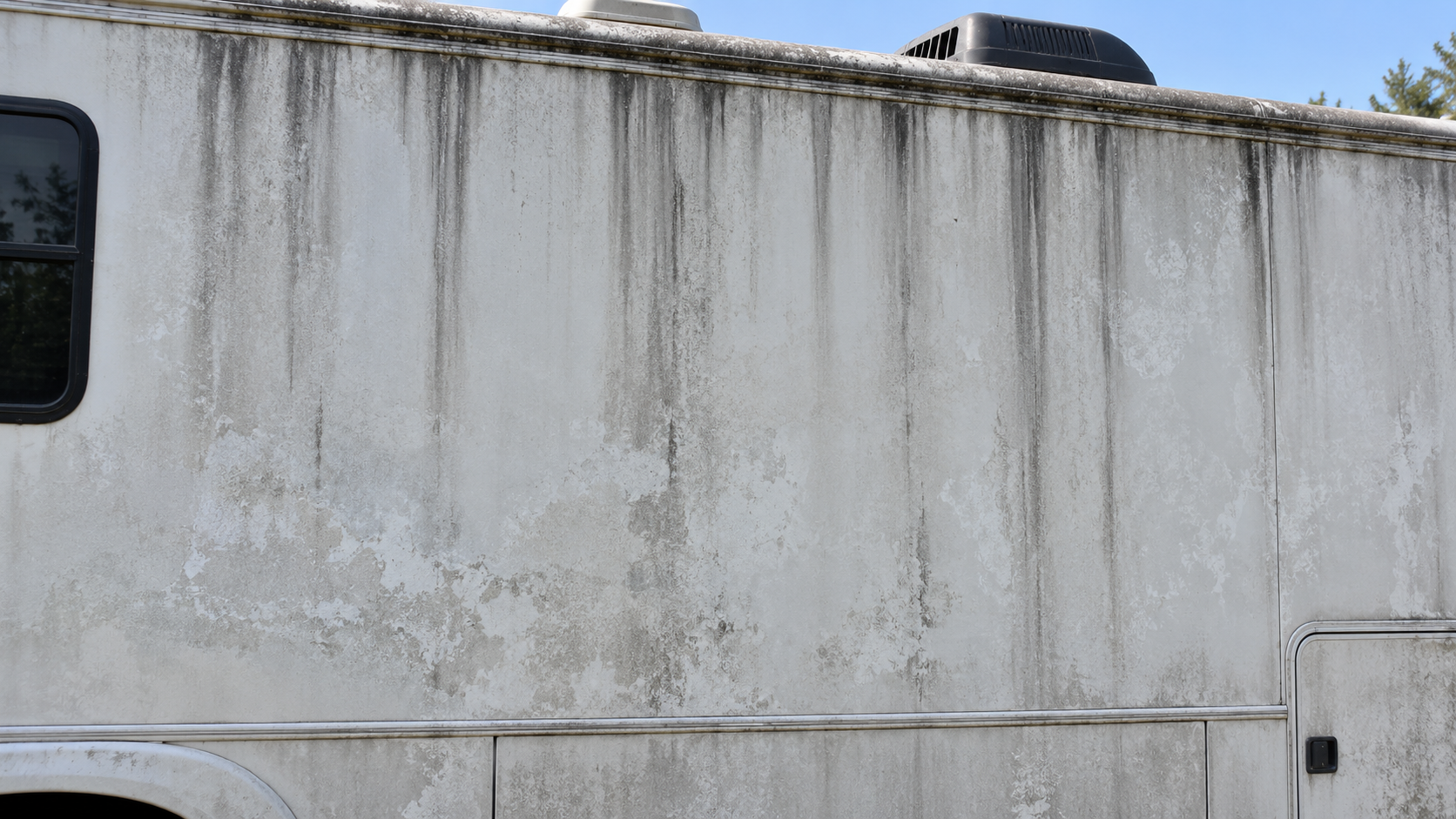
Before — oxidised gelcoat, streaked
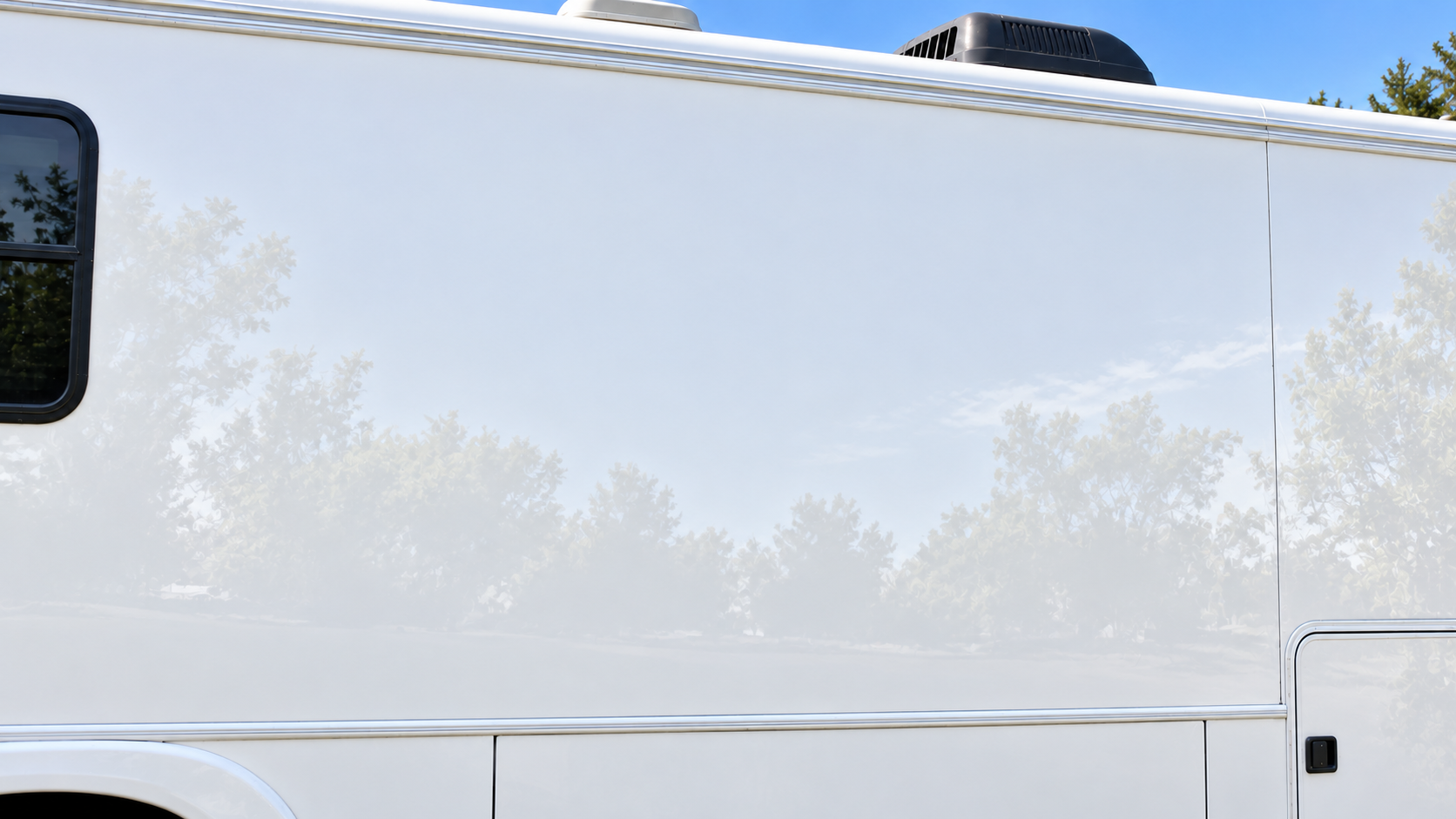
After — compounded, polished, coated
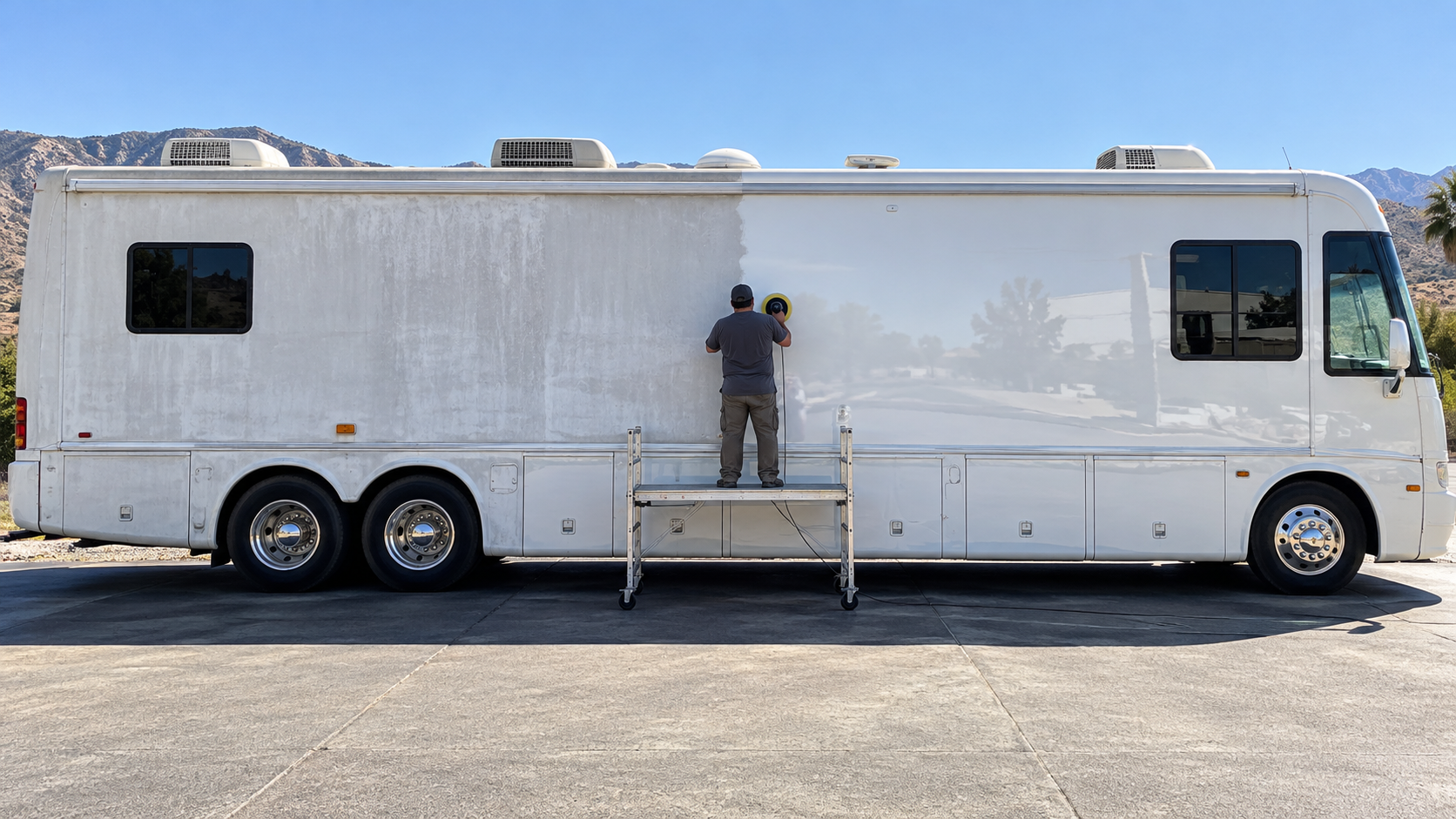
A 40-footer is several cars’ worth of surface
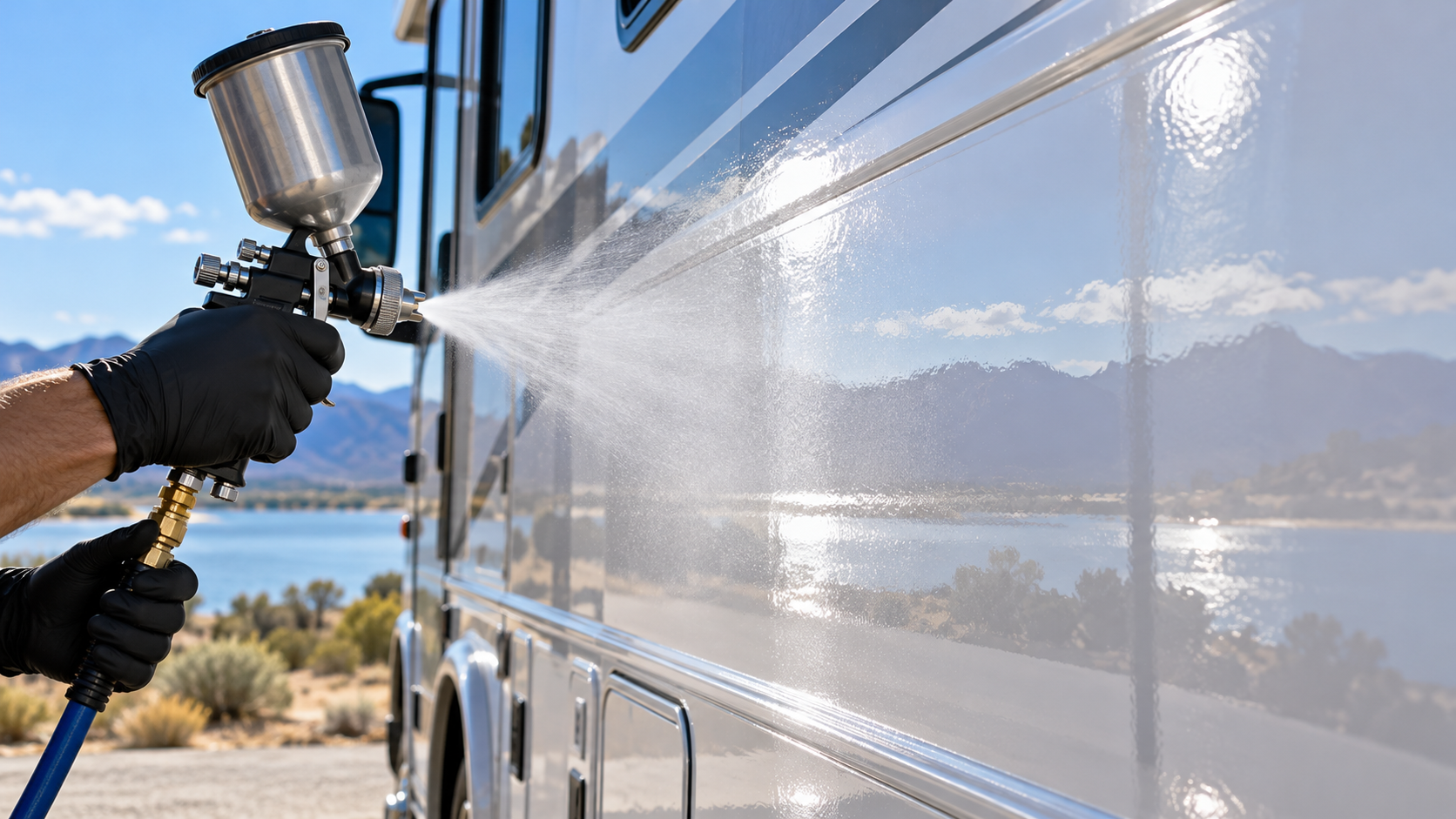
Sealed in through the cure — the aircraft method
Four surfaces, four different answers
An RV is not a big car
A coach is several materials bolted together, and the thing that restores one of them will ruin another. Knowing which is which is most of the job.
Gelcoat sidewalls
Compound, then coat
Oxidises chalky in the sun. Cut back to sound gelcoat, then sealed.
Rubber roof
EPDM / TPO
Cleaned, never compounded. Sidewall products damage membrane roofs.
Vinyl graphics
Worked around
Faded decals come off under a machine pad. Hand work only, by hand.
- Coated out in the open using the aviation protective spray over the cure — the method we have run on private aircraft since 2019
- Priced per linear foot, so a 24 ft trailer and a 40 ft coach are quoted on the same honest basis
- Oxidation assessed before quoting — the depth of the chalking moves the price more than the length does
- Roof sealant inspected and photographed, because that is where the black streaks and the eventual leaks start
- Done where it is parked — your property, a storage yard or an RV park
- We will tell you when it is an RV tech’s job rather than ours
Per linear foot — mobile included
What an RV costs
Prices shown are card prices. Pay by cash or check and the lower price applies — shown in green beside every price on this page. No fee is ever added at checkout; the price you see is the price you pay.
Everything is priced by the foot — one rate, whatever the height. A 13 ft Class A and a 9 ft travel trailer pay the same per foot.
RVs, motorhomes, trailers & campers — one rate, any height
Exterior wash + bug & tar removal
$20.70 / ft$20 / ft cash
Exterior wash + bug & tar removal + wax
$25.90 / ft$25 / ft cash
Add-on services
Light single-stage machine buff & polish
$12.45 / ft$12 / ft cash
Heavy multi-stage machine buff & polish
$25.90 / ft$25 / ft cash
Chrome, aluminum & stainless polishPriced by the square foot
$2.10 / sq ft$2 / sq ft cash
Chrome, aluminum & stainless — heavy multi-stagePriced by the square foot
$5.20 / sq ft$5 / sq ft cash
Ceramic Infused Super ProtectionTechnicians Choice G-MAX Pro
$10.35 / ft$10 / ft cash
$25.90 / ft$25 / ft cash
$67.30 / ft$65 / ft cash
Stealth Diamond Borograph CeramicIncludes wash, bug & tar removal, decontamination & clay bar
$103.50 / ft$100 / ft cash
Liquid PPF + Stealth Diamond BorographIncludes wash, bug & tar removal, decontamination & clay bar
$207.00 / ft$200 / ft cash
Toy box, box and horse trailers, motorhomes and campers — one rate regardless of height. Custom quotes for interior detail, water spot removal, trim restore and rust removal. Coatings on these units are not covered by the NanoPro vehicle warranty, but carry the same lifetime expectancy on our maintenance program with an annual detail and ceramic refresh.
What that works out to
24 ft travel trailerFull exterior detail · permanent ceramic
from $622 · $2,484$600 · $2,400 cash
32 ft fifth wheelFull exterior detail · permanent ceramic
from $829 · $3,312$800 · $3,200 cash
40 ft Class AFull exterior detail · permanent ceramic
from $1,036 · $4,140$1,000 · $4,000 cash
Starting figures at the base rates, before any oxidation correction the coach needs. We would rather show you the arithmetic than make you ask for it.
Keep it that way
Maintenance programMonthly deluxe detail for coated vehicles — 25% off
from $195 / mo$188 / mo cash
Horse trailersSame per-foot pricing, aluminum-specific process
from $20.70 / ft$20 / ft cash
Gift certificatesAny service, any amount
Available
A coated coach washes in a fraction of the time and stops streaking, which is the part owners notice first. Correcting oxidation without sealing it means doing the same work again in two or three seasons.
13 years in business
5,000+ vehicles
Aircraft since 2019
Fully insured
All cards, cash, check, Venmo & PayPal
100% satisfaction guaranteed
In our customers’ words
Five stars, every one
Google Reviews
Shown word for word
These reviews are from Zippy Klean’s Hawaii customers — same owner, same crew standard, now in San Diego.
Excellent job on an old car and Grace was lovely. I would use them again and highly recommend them to anyone.
The guys at Zippy Klean did a great job buffing the scratched up dull paint job on my old Prius and making it shine like new. Appreciate, the really professional, friendly and speedy service, which included dropping me by a coffee shop while I waited. Couldn't be happier with Steven's team. Thanks!
No obligation
Get your coach quoted
Tell us the length and send daylight photos of the worst sidewall. We bring our own water and power, so the coach can sit anywhere: your property, a storage yard or an RV park.
Prefer to talk? (858) 808-1244 — call or text, Mon–Sat.
Straight answers
RV questions
How do you ceramic coat an RV without a shop?
We use an aviation protective spray applied over the coating while it cures — the method used on private aircraft, which can only be detailed and coated out on the tarmac. Instead of sealing the environment out, you seal the coating in.
A coating cures on the panel, so dust, pollen and overnight moisture landing on it during that window become part of it permanently. Enclosed bays solve that for cars, but no portable bay goes over a 40 ft coach, and anyone promising you a dust-free tent over one is overselling.
We have been detailing and coating private jets and aircraft in Hawaii since 2019, which is where this comes from. It is not a workaround invented for motorhomes — it is how the aviation side of our business has always worked, on aircraft worth considerably more than an RV.
The practical result is that your coach gets coated where it is parked, whether that is your property, a storage yard or an RV park. We bring our own water tank and generator, so no hookup is needed on site.
Why does my RV sidewall look chalky?
Fiberglass gelcoat oxidises in sunlight — the resin at the surface breaks down and leaves a chalky, faded layer that makes a white coach look grey and a coloured one look washed out. Wipe it with a dark cloth and the cloth comes away chalky.
This is the single most common thing wrong with an RV in Southern California, and it is not dirt. Washing will never touch it. It has to be cut back with compound until you reach sound gelcoat underneath.
How far gone it is decides the job. Light oxidation comes back with a single-stage polish; heavy chalking needs multi-stage compounding. We will tell you which after looking at it, and the difference in price is significant enough that guessing is not fair to you.
What are the black streaks down the side of my RV?
Black streaks are runoff — dirt and degraded sealant washing off the roof and running down the sidewalls in the rain, where they stain oxidised gelcoat because the chalky surface holds onto them.
The streaks are a symptom. They appear on oxidised coaches and not on sealed ones, because a sound, sealed surface has nothing for the runoff to grip. Scrubbing them off every few months is treating the symptom.
Correcting the oxidation and then coating the sidewalls is what actually stops them coming back, which is the main reason RV owners end up coating rather than just washing.
Can you polish over my RV graphics and decals?
No — machine compounding over factory vinyl graphics will damage or remove them, especially once they have started to fade and crack, so decals are worked around by hand rather than polished through.
This matters because RV graphics are expensive and often no longer available for older coaches. A compound pad run across a sun-brittled decal takes the decal with it, and there is no putting it back.
Faded, cracked or lifting graphics are worth a conversation before we start. Sometimes the honest answer is that the coach looks better with the old decals removed entirely than with them polished around.
Do you clean and treat the RV roof?
We clean RV roofs, but rubber roofs — EPDM and TPO, which is what most coaches have — are not treated the same way as the sidewalls, because sidewall products and compounds will damage them.
The roof is also where we find things. Failing sealant around vents, skylights and the AC shroud is the usual cause of both the black streaks on your sidewalls and, eventually, a water intrusion problem inside.
If we see sealant that is cracked or lifting we will tell you and photograph it, but resealing a roof is an RV service job rather than a detailing one. We are not going to take money for a repair that needs a different trade.
How much does it cost to detail and coat an RV in San Diego?
RV and motorhome work is priced per linear foot at one rate regardless of height: $20.70 per foot for a wash with bug and tar removal, $25.90 per foot with wax added, $103.50 per foot for permanent Stealth Diamond Borograph ceramic, and $207 per foot for Liquid PPF with Stealth Diamond.
So a 32 ft fifth wheel starts around $829 for a full exterior detail and around $3,312 for a permanent ceramic coating. A 40 ft Class A starts around $1,036 and $4,140 respectively.
Oxidation is the variable that moves the number. Gel coat oxidation removal runs $25 to $67.30 per foot depending on how deep the chalking goes, and a coach that has sat in the sun for eight years is a different job from one that has been kept up, at the same length.
Send photos of the worst sidewall in daylight and we will price it properly rather than quoting the high end to protect ourselves.
Mobile — we come to you
Book your spot
(858) 808-1244San Diego County to Temecula. Mon–Sat by appointment.